


The Thread Remembers

The beauty of a Banarasi saree lies not only in its colour or zari, but in the technique behind it. From Tanchoi and Kadhua to Kadiyal, Cutwork, Ektara, pure and semi pure zari, each detail carries a different rhythm of the loom.
A Banarasi saree is often remembered by its colour. A red chosen for a wedding. An ivory kept aside for a quieter ceremony. A deep jewel tone that catches light in the evening. A border that appears in a photograph long after the occasion has passed.
But colour is only the first meeting.
The real character of a Banarasi saree lies deeper — in the way it has been woven, in the patience of its motifs, in the structure of its border, in the density of its surface, and in the decisions made before the first thread moves on the loom. In Banaras, technique is not a technicality. It is the difference between a saree that only looks beautiful and a saree that carries the memory of how it was made.
To understand a Banarasi saree, one must begin with its weave.
Every handwoven saree has a visible life and a hidden one. The visible life is the silk, the zari, the colour, the pallu, the buti. The hidden life is what made those details possible: the loom, the thread, the interlocking of colours, the planning of the design, and the hand that guides it all.
This is why two sarees may look alike in a photograph and feel entirely different when understood closely. One is light and fluid; another dense and ceremonial. One relies on a subtle shift of colour; another carries motifs placed with great patience across the body. These differences are not accidents. They come from technique.
The vocabulary of Banaras — Tanchoi, Kadhua, Kadiyal, Cutwork, Ektara — is not meant to confuse the buyer. It is meant to help her see what the loom has done.
Types of Banarasi Weaves, Explained
Tanchoi: The Quiet Density of Silk
Tanchoi does not announce itself loudly. Its beauty lies in closeness — close colours, close weaving, close attention. It is known for a dense, silk-rich surface where the design emerges through subtle shifts of thread and tone, sometimes within the same colour family, sometimes in restrained contrast.
A Tanchoi saree is not about empty space. It is about surface richness: the fabric feels filled, layered, almost embossed, as if the silk has been persuaded to hold pattern within itself. A well-made Tanchoi is often recognised by how cleanly the pattern sits within the weave, without the long loose floats one may see in some other techniques. That is part of what lets it stay smooth and wearable despite all its detail.
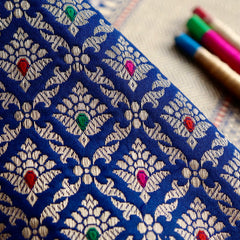

This is a weave for someone who enjoys ornament that reveals itself slowly — festive, but not loud; intricate, but graceful.
Kadhua: The Patience of One Motif at a Time
Kadhua is one of the most respected words in the Banarasi vocabulary, because it carries patience visibly. Here, each motif is woven individually rather than carried across the fabric in a continuous run. Each one is brought into the saree with deliberation.
This gives Kadhua a different dignity. A Kadhua buti does not feel like a repeated stamp — it feels placed, considered, sitting on the body of the saree almost like jewellery. The proof is on the reverse: a well-executed Kadhua motif leaves the back relatively clean, without the long loose floats that may appear in some other methods. Each motif is finished in its own right.


Kadhua is slow. In a world trained to value speed, that is precisely its strength.
Kadiyal: When the Border Becomes Architecture
Some sarees are remembered by their borders — not because the border is heavy, but because it is decisive. It frames the body, gives the drape its discipline, and decides how the saree appears when pleated, photographed, or worn across the shoulder.
Kadiyal is valued for this architecture of contrast. The body and border carry different colours while still belonging to the same textile, woven together rather than joined. The tell is at the join: in a well-executed Kadiyal, the colour changes cleanly at the border with no seam and no separate strip stitched on — the contrast is structural, interlocked on the loom. The body may stay quiet while the border carries strength, or the contrast may be bold enough to give the whole saree a ceremonial presence.


A good Kadiyal understands proportion. Too dominant a border overpowers the wearer; too timid, and the contrast loses its purpose. Done well, the border does not decorate the saree. It gives the saree its posture.
Ektara: The Beauty of Surface and Hand-Feel
Some weaves are understood less by how they look than by how they feel in the hand. Ektara belongs to that quieter space — its defining quality is the smooth, shining surface it gives the saree. Ektara is a term best understood through the saree in hand — its surface, fall, lightness, and finish. It is rarely the loudest weave in a room, and often one of the most graceful.

At Stuti Weaves, we believe technique should always be explained in relation to the saree in front of the customer — its fabric, its surface, its fall, its motif, its finish. The name matters. The textile matters more.
Cutwork: A Different Logic of Pattern
Cutwork is often compared with Kadhua, but it should be understood on its own terms, not dismissed. Here the patterning thread travels across the reverse of the fabric, and the extra threads are later cut away. The tell is the back: a Cutwork saree shows the trimmed ends of those cut floats across the reverse, where a Kadhua saree would show individually finished motifs. This is a different labour structure, and usually a different price point.


That difference matters. A Cutwork saree can still be beautiful, still handwoven, still carry the visual richness of Banaras — but it should be named honestly. A customer should never be made to feel that every Banarasi-looking motif carries the same labour. The front of a saree charms the eye; the reverse tells the truth of the weave. The role of a preservation-led brand is not to blur the two, but to help the buyer see each for what it is.
The clearest way to understand a weave is to compare two backs side by side.
Kadhua
Each motif is finished in its own right. The back stays relatively clean, with no long threads travelling between motifs.
Cutwork
The pattern runs across the fabric and the extra threads are cut away, leaving trimmed ends visible across the reverse.
Both are handwoven. Both are beautiful on the front. But the reverse shows how each was made — and that is what we want you to be able to see in our product photography, not just take on trust.
Zari, Light and Honesty
Zari is often the first thing people notice. It catches light before the weave has had time to explain itself. But zari, too, has a language.
Some Banarasi sarees are made with pure zari, and these belong to a separate, rarer category. They should be named carefully, only when the material is genuinely documented. Many contemporary handwoven Banarasi sarees use semi pure zari, which holds the glow, depth, and festive character associated with Banaras while remaining wearable and honest about what it is.
There is no need to inflate either category. A saree does not become valuable because its language is exaggerated. It becomes valuable when its material, technique, hand, and time are understood clearly.
A saree is not only an image. It is evidence of making.
Why Technique Changes Value
The price of a Banarasi saree is not decided by beauty alone. It is shaped by the fabric, the zari, the density of work, the complexity of the design, the time taken on the loom, the finish, and the technique behind the motifs, borders, and pallu.
This is why two sarees can both be handwoven and sit at very different price points. One is lighter, simpler, easy to wear often; another is dense, labour-intensive, suited to weddings or heirloom use. Understanding technique helps the buyer stop comparing sarees by colour and price alone, and start asking better questions:
How was the motif created? What does the reverse side look like? Is the border woven in contrast? Is the saree dense or light? Does it carry pure zari or semi pure zari? Is it meant for frequent wear, bridal use, or preservation as an heirloom?
These questions do not make buying complicated. They make it honest. And in handloom, the back of a saree answers most of them — whether the motif was individually worked, whether threads have travelled across the fabric, whether extra yarns have been cut. For an online buyer, this matters even more. Styled photographs are beautiful, but they are not enough.
The Stuti Weaves View
We believe the vocabulary of Banaras should not be hidden behind difficult words. A customer should not have to buy blindly. She should be able to understand why Kadhua takes more patience, why a Kadiyal border feels so distinct, why Tanchoi carries a dense silk surface, why Cutwork has its own place, why zari must be named honestly, and why the back of a saree matters as much as the front.
To preserve Banarasi handloom, we must preserve more than finished sarees. We must preserve the language that helps people understand them.
Because once a buyer understands the weave, she does not look at a saree the same way again. She begins to see the time. She sees the hand. She sees the decision behind the motif, the structure behind the border, the reason one saree is meant for an occasion and another for inheritance.
That is the real enchantment of Banaras — not only that its sarees are beautiful, but that their beauty has been built, thread by thread, through techniques worth remembering.
Need help understanding which weave is right for a wedding, festive occasion, or heirloom purchase? We would be happy to guide you.
Message us on WhatsApp