


The Naqshaband: The Drawing Before the Thread

Before a Banarasi exists in silk, it exists on paper. This essay is about the man who draws it — and the two translations that carry his drawing into cloth.
The man before the loom
Every craft keeps one figure the photographs forget, and in Banaras it is the naqshaband. The word comes from Persian — naqsh, the design; the naqshaband, the one who binds it — and the craft documentation puts his role in a single sentence: the naqsha is the design, and the naqshaband is the designer. He arrived with the technique itself, in the long migration of drawloom knowledge from Persia and Central Asia, and he has never been merely a draftsman. A naqshaband inherits a vocabulary — generations of janglas, butis, kalgas, hunting scenes — the way a court poet inherits metres, and his drawings have absorbed whatever the trade routes brought past his table: Persian vines, Chinese clouds, Ottoman medallions, even, in the colonial century, the patterns of European wallpaper. The garden that refuses to end begins at his desk, one pencil square at a time.
The drawing
The naksha is drawn on gridded paper — the likhai — and the grid is not decoration but machine code before machines: each square stands for one crossing of warp and weft, so the drawing is simultaneously a picture and an instruction set. It is also where the stakes live. An incorrectly rendered naksha weaves a misshapen motif — and by the time the error is visible, it has already been paid for in silk, in zari, and in weeks of a weaver's days. This is why the naqshaband's accuracy is spoken of in Banaras with the respect other trades reserve for surgeons. The weaver executes the saree. The naqshaband decides, in advance and irrevocably, what the saree is.
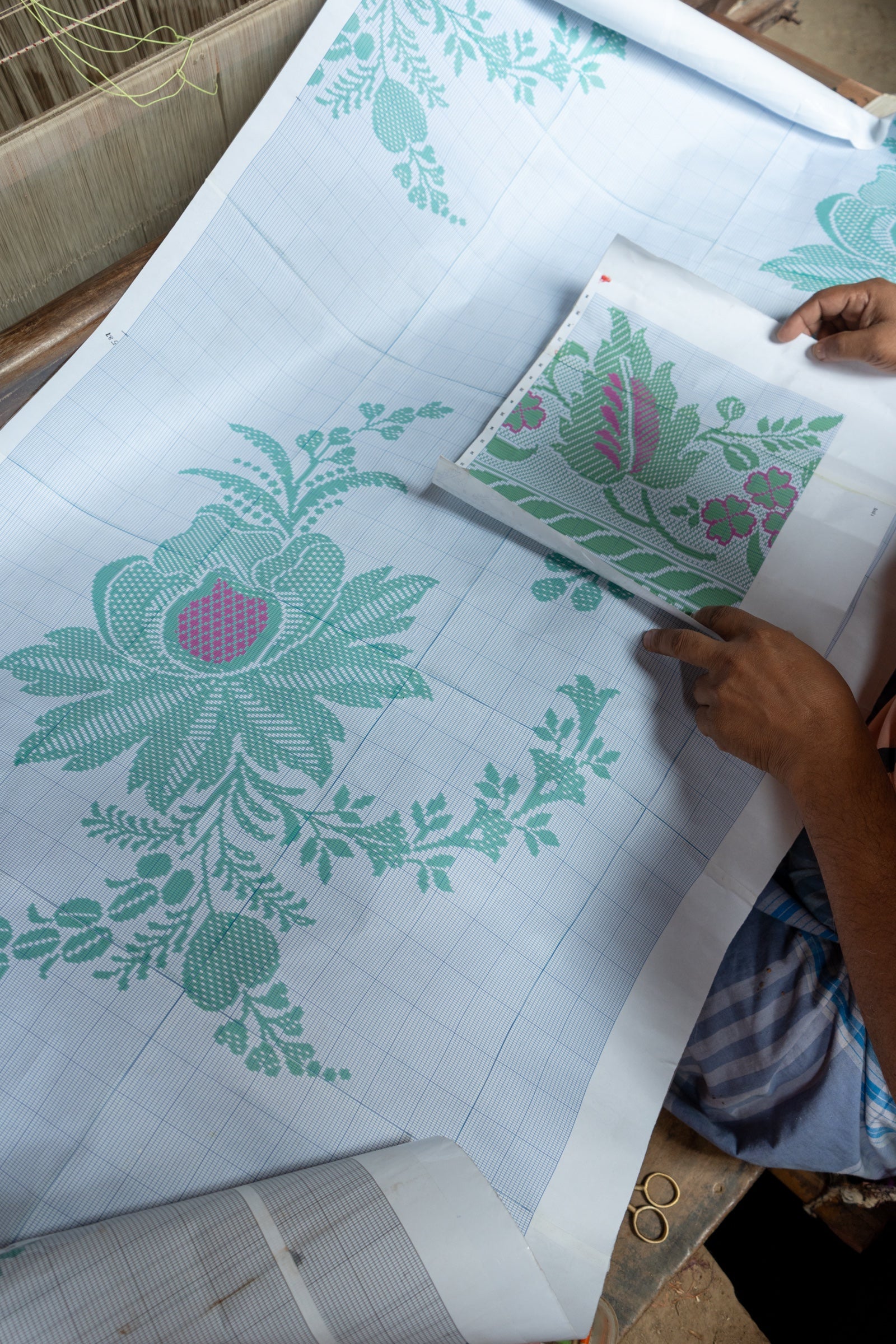
The jala: a drawing tied in thread
For centuries, the drawing's first translation was itself woven. The naqshaband tied his pattern into a lattice of cotton threads — the naksha in its physical form — which was mounted above the loom as the jala, a net-like master harness. Row by row, as the weaving advanced, its cords lifted exactly the warp threads the drawing demanded while the weaver passed the pattern weft beneath: a design, suspended overhead, dictating the cloth below. And here is the detail worth treasuring: the jala is not a museum word. Craft scholars documenting Varanasi in recent years found master weavers still working drawlooms for the most special pieces — the old translation, alive in a handful of rooms.
The cards: a drawing punched in cardboard
The second translation arrived in the early 1930s, when the weavers of Alaipura brought jacquard machines to the city's pit looms. The logic did not change — only the material. Today the naqshaband's graph goes to the patthakati, the card-puncher, who renders it as holes in cardboard cards — the naksha pattas — laced into a long loop and hung on the loom, each card's holes selecting the warp lifts for a single pick. An ordinary saree needs between 1,500 and 2,500 cards; an elaborate one can demand ten times as many. Stand in a weaving lane and you can hear it: the cards turning overhead, clacking through the pattern like a rosary of the design. Punched cards instructing a machine, a century before anyone called it software — the loom got there first, and Banaras adopted it without surrendering the hand that throws the shuttle.

Eighteen pairs of hands
The naqshaband also explains something buyers sense but rarely name: a Banarasi is not one person's work. The documentation of the craft counts the chain — the workshop head, the naqshaband, the card-puncher, the warp-setters, the dyers, the karigar at the loom, the thread-cutters and finishers — a dozen and more specialist hands before the saree is folded for the first time. On a Kadhua piece, where each motif is woven separately and finished in its own place, the drawing's discipline runs all the way down to the last buti. When this Journal says a saree carries time, this is the time it means: not one craftsman's weeks, but a whole small civilisation's.
References
Sahapedia – Documentation of the naksha, the jala drawloom and the weaving chain of Varanasi.
Dastkari Haat Samiti, with Google Arts & Culture – The making of a Banarasi: naqshaband and card-punching documentation.
Global InCH, Craft Revival Trust – Encyclopaedia entry on naqshabandi and jacquard naksha pattas, Varanasi.
The weaver gives the saree its body.
The naqshaband gave it its mind.
Every jaal and jangla in the collection began as a naqshaband's drawing — ask us about the design of any piece and we will tell you its story plainly.
Discover the Collectionor ask on WhatsApp