


The River Remembers the Silk

The second page of our Banaras Notebook walks from the baithak down to the water — because the city that weaves is also the city that bathes, trades, and remembers at the river.
The city's front porch
Every city keeps one place where it meets the world, and Banaras built its own out of stone steps. At first light the ghats hold everything the city is at once: the bathers and the boatmen, the priests and the pilgrims, the wrestlers at their morning akhara, the laundry beaten bright against the stone, the tea seller who has watched a thousand sunrises without once mentioning them. This is the Banaras the world photographs — and rightly, because there is nowhere else like it. But the Notebook's job is to notice what the postcard leaves out: nearly everything the city makes is made elsewhere, inland, in rooms the river never sees. The ghats are not the workshop. They are the front porch of one of the world's oldest workshops.
The river does not weave — it collects
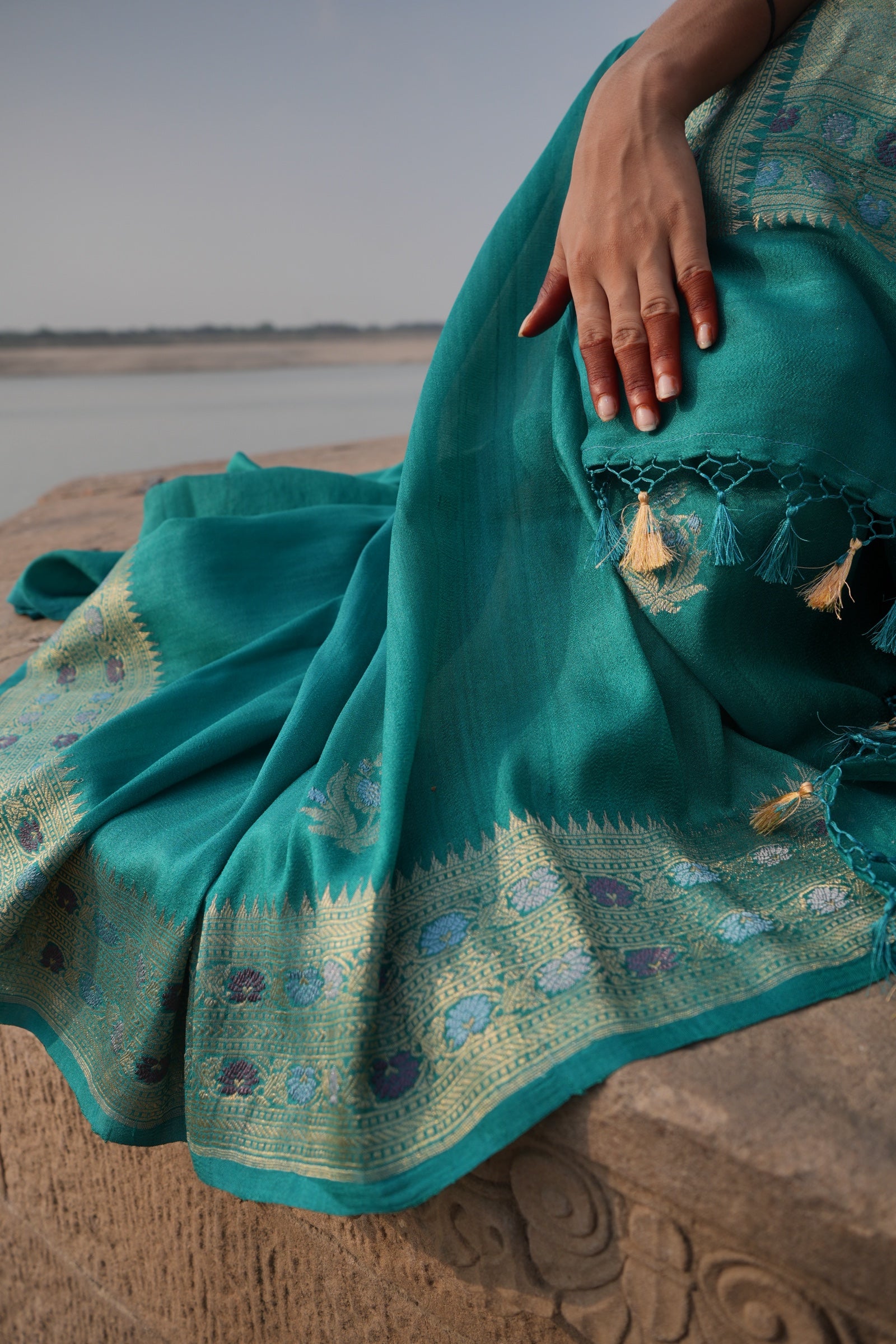
The looms live in the lanes — in Kamachha and the weaving quarters, where the wooden knock of the shuttle comes through open doorways and the warp outlasts the news. The river's role was always different: it was the city's great connector. For centuries, goods, pilgrims, merchants and ideas moved along this water and the roads that shadowed it, and the silk of Banaras moved with them — out to courts and markets that spoke other languages but understood zari perfectly. The river did not make the cloth. It carried the cloth's reputation, and brought back the world's appetite for more.
Something of that arrangement survives in how the city still sells its silk. Banaras trades the way it prays — seated, unhurried, by relationship rather than by transaction, at the pace of water rather than the pace of traffic. The baithak and the ghat are the same institution in two materials: a step to sit on, a reason to stay awhile, and the understanding that nothing important in this city has ever been rushed.
Why the Notebook keeps returning here
Because the ghats explain the city's temperament better than any essay could. These steps have been built, flooded, silted, and built again around the same river for centuries — repaired rather than replaced, continued rather than reinvented. That is precisely the temperament that keeps re-threading the same looms, teaching the same motifs to the next pair of hands, and treating a saree not as a product with a season but as a thing with a lineage. A city that rebuilds the same stairs for five hundred years is a city that will keep weaving the same garden — and mean it freshly every time. Continuity is not Banaras's habit. It is Banaras's craft.

If you walk it
Then do it the city's way. Come at first light, before the day's business, when the stone is cool and the river is the loudest thing present. Walk slowly; the ghats reward the pace of the baithak, not the pace of the itinerary. And when the sun is properly up, turn inland — fifteen unhurried minutes from the water — to the other Banaras, the one with thread on its hands, where the studio at Kamachha receives visitors the old way: sit first, chai first, silk afterwards. The river and the loom are one morning, taken in the right order.
The river keeps the city's time.
The loom keeps its word.
If Banaras is on your horizon, come — the ghats at first light, then the baithak at Kamachha, by appointment, so the family can receive you properly.
Visit the Studioor let the city come to you, one saree at a time, on WhatsApp